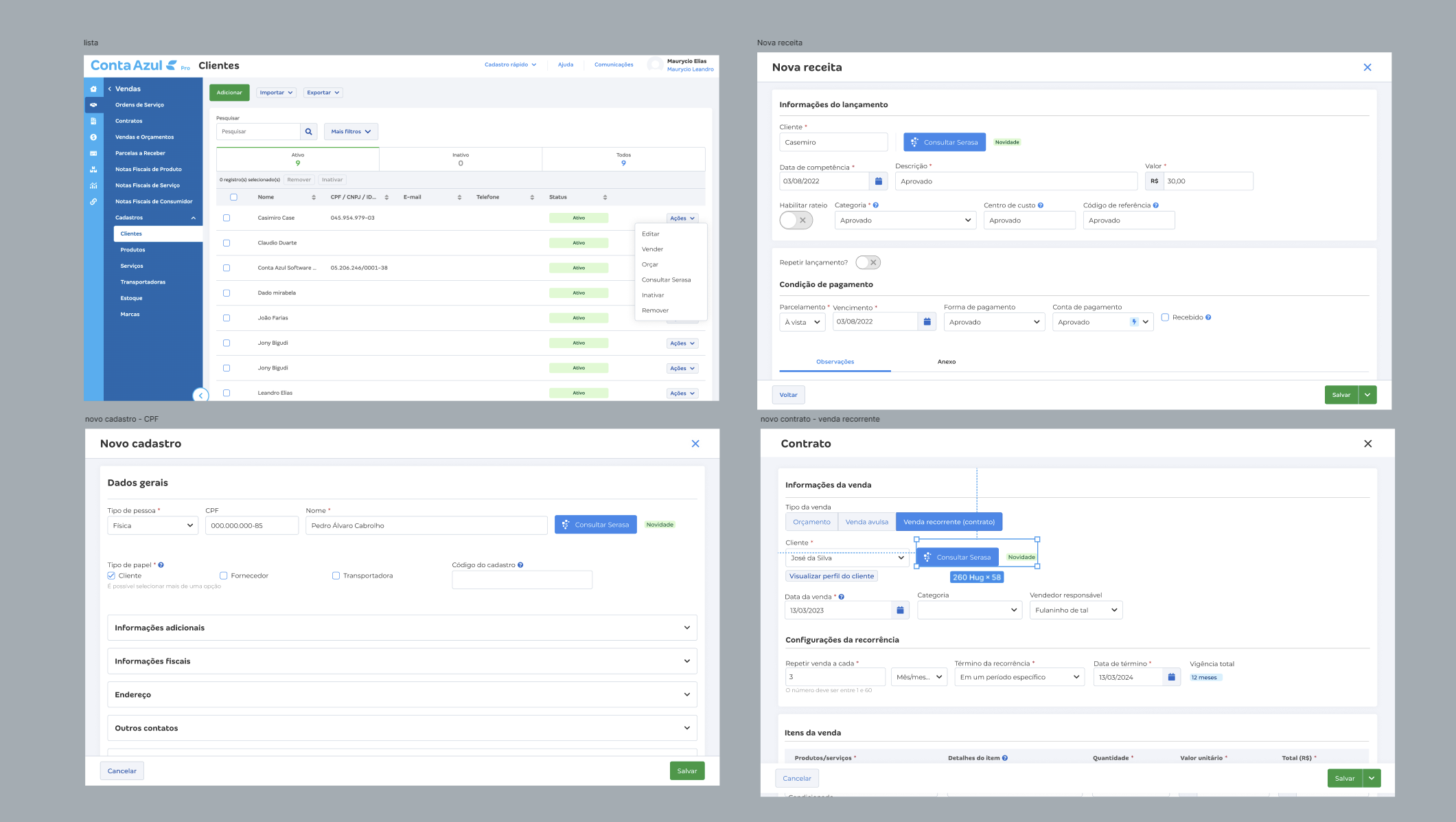
Launching a new revenue stream inside an ERP through a paid, trustworthy, discoverable feature
Monetization
Launch
Revenue
B2B SaaS
Discoverability
Context
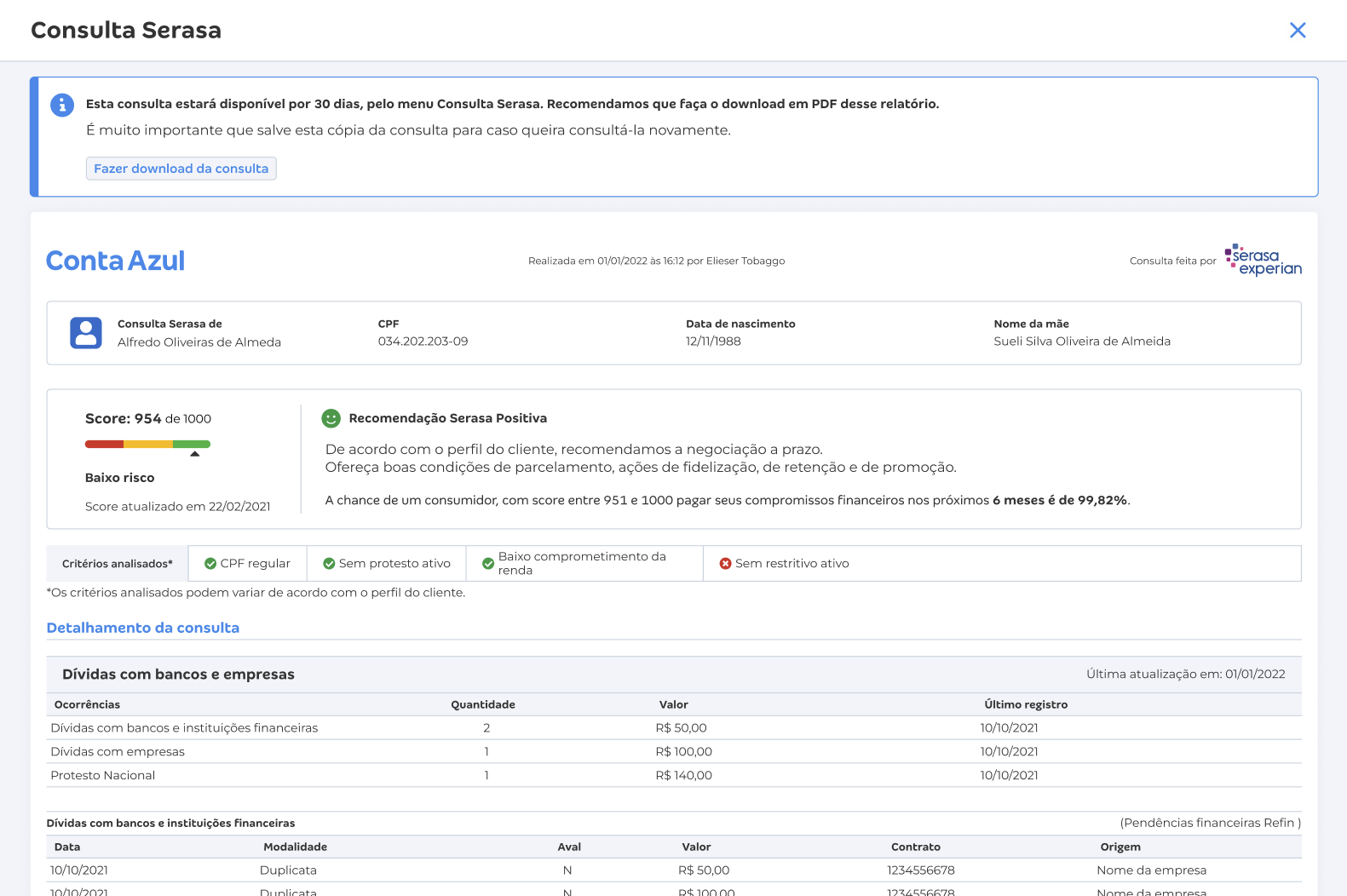
Conta Azul needed to expand revenue beyond the subscription. Serasa Experian had credit data that ERP users needed, but no channel inside the product to access it.
Problem
A paid, trust-sensitive feature with no presence in the actual workflow. The user who most needed the credit-risk check didn't know it existed.
Approach
Contextual MVP inside the one-off sale flow → research with non-users, light users and frequent users → V2 with multiple entry points, including a direct check with no prior sale required.
Result
+677% volume after V2, R$213,464 in cumulative revenue over 6 months, and validation of a reusable monetized add-on model.
Results
337Unique users in the MVPControlled window
16%MVP conversionPay-per-check
R$8,889Projected MVP revenueContextual channel only
+677%Volume increaseMVP → V2
R$213,464Cumulative revenueNov/2023 – Apr/2024
12,613Checks in the periodAll entry points
3,300+Peak monthly checksBest month
Role
The project started at the end of 2023 as a revenue bet for 2024, with an OKR of R$268k in revenue via a paid add-on model.
My scope had three fronts running at the same time:
Define — the interaction model for a paid feature inside a trust-sensitive transactional flow
Coordinate and analyze — the research with three user profiles after the MVP
Redesign — the entire access architecture in V2
The most important decision here was one of product positioning, more than interface: creating the direct check as an independent entry point, without forcing the user to start a sale first. It came from research with people who weren’t using the feature, not from an internal guess.
Strategy
The challenge had three overlapping layers:
Discoverability — making a new feature visible without breaking the existing flow
Trust — getting the user to pay for a check inside a product they already subscribe to
Business model — structuring an add-on offer that could be replicated with other partners
Solving discoverability alone without trust would generate checks and cancellations. Solving trust alone without discoverability would leave revenue stuck. The MVP → research → V2 sequence was exactly the mechanism to attack the three layers in order, each phase learning from the last before widening scope.
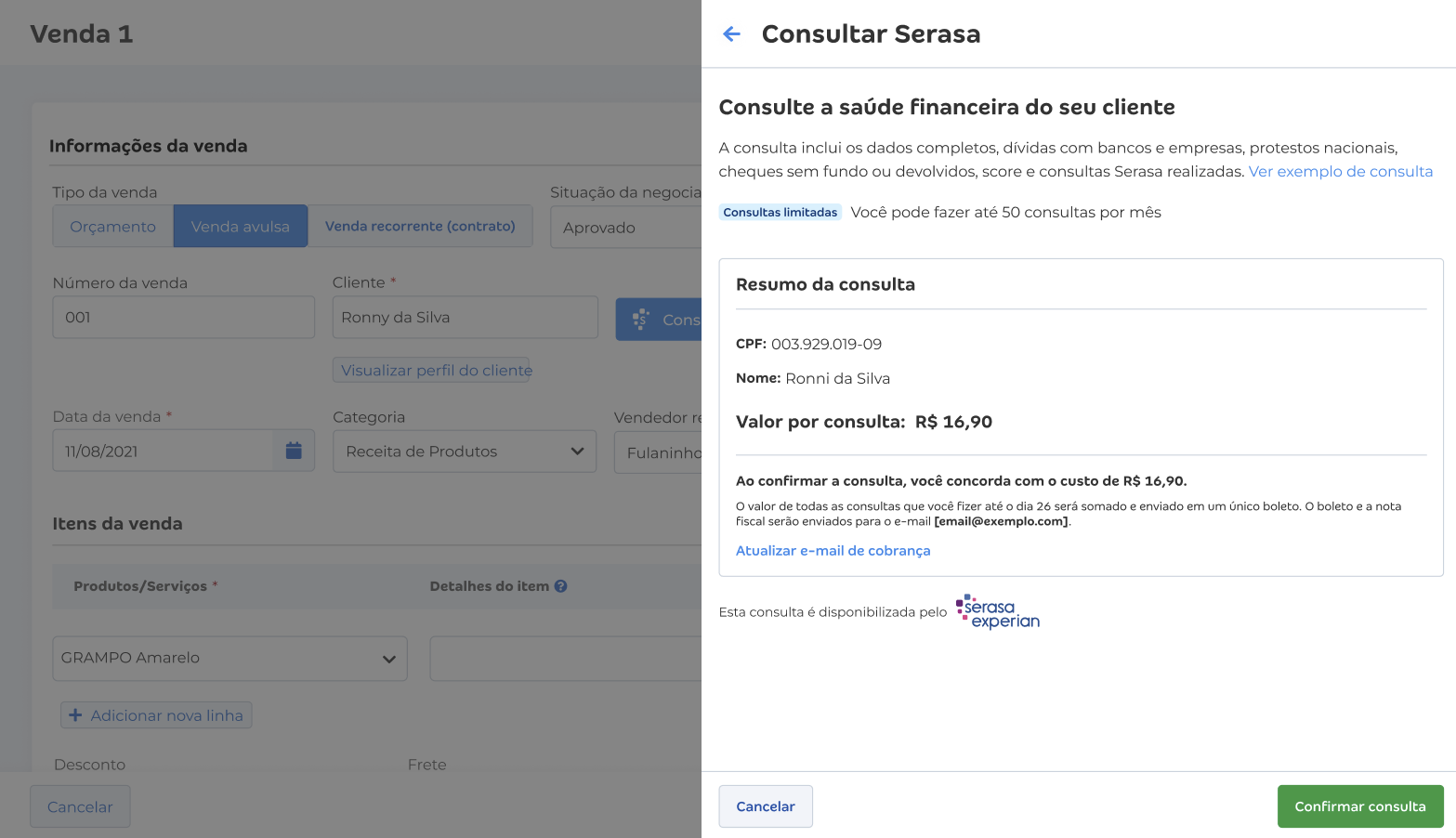
The offer’s financial structure made clear that design had to get it right early: R$16.90 per check, a cap of 30 per month, post-paid billing via monthly invoice. That created real tension, because default risk was the main operational risk the team had mapped, and post-paid billing already went in as a temporary solution. The design needed to generate enough trust for the user to agree to pay for something they hadn’t seen yet, and enough volume for the financial model to hold until an eventual shift to prepaid.
Process
This initiative’s structure was deliberately incremental: an MVP to validate willingness to pay before scaling investment; research with three usage profiles to understand why non-users weren’t using it; and a V2 with an expanded entry architecture derived from the research findings.
I launched the MVP with a single entry point, inside the one-off sale creation flow, to control variables and measure conversion under the leanest possible conditions. The 337 unique users and 16% conversion weren’t read as final success, but as a green light to invest in qualitative diagnosis before scaling.
The average score of 4.5/5 in the post-use survey was read as an opportunity: evidence that the problem was discoverability, not satisfaction. Whoever found the feature liked it. V2 was built entirely on top of that diagnosis: removing the contextual barrier and making the check accessible the moment the user actually needs it, before the sale rather than during it.
Lean
Non-User Research
Research-Led
Revenue Metrics
Diagnosis
Every design decision was built on a structured diagnosis phase with four methods.
Question: Were users who did use the feature satisfied, or was the problem also one of delivery quality?
What was done: Survey sent to users who had run at least one check in the MVP. Measured overall satisfaction with the feature via a numeric score and an open field for suggestions.
Key finding: Average score of 4.5/5. The suggestions field was practically empty. No sign of a quality, usability, or perceived-value problem. This result flipped the initial hypothesis on its head: the bottleneck was in access, not in the usage experience.
Artifact: Aggregated quantitative survey results; base: active MVP users.
Question: What differentiates the behavior and usage context of people who ran more than one check versus those who ran just one?
What was done: Video-call interviews with two profiles: (a) users who ran only one check and never came back; (b) users who ran more than one check recurringly. Semi-structured script focused on work context, decision moment, perceived value, and barriers.
Key finding: The recurring profile concentrated in B2B companies with high-value individual sales or a medium-to-high volume of new customers, who ran a check as a standard step before closing any deal. Those who ran just one check didn’t come back due to lack of immediate need, not dissatisfaction. Both groups evaluated payment method and terms before checking, and some checked every new customer by default, which shows that perceived value sustained recurrence when the context supported it.
Question: Why did users who showed interest in the MVP never actually run a check?
What was done: Phone calls with users who had accessed the feature but not converted, the “interest without use” profile. Direct approach, no formal script, focused on reconstructing the decision moment and finding the real barrier.
Key finding: Two critical findings. First: many people clicked “Learn more,” a sign that pre-launch communication hadn’t reached them, and the user landed on the feature with no context to trust and pay. Second: a recurring request to be able to run a check without registering a customer or starting a sale. This second finding directly drove the decision to create the direct check as an independent entry point in V2.
Artifact: Qualitative synthesis of calls; findings coded under the VISIBILITY and USABILITY themes.
Question: Did any aspect of the offer (price, data scope, validity) create real friction in the decision to use it?
What was done: During interviews and calls, spontaneous mentions of problems with the offer itself were mapped: price per check, comparison with direct Serasa plans, completeness of the returned data, and the 30-day validity for reusing a check at no extra cost.
Key finding: A user who had previously been a Serasa direct-plan customer found the value less competitive by comparison. There was also demand for data the launched version didn’t include (equity capital, ownership structure). These findings confirmed the offer had limits, but they weren’t the main bottleneck: most non-users hadn’t even reached the point of evaluating price.
Artifact: Qualitative synthesis; findings coded under the OFFER theme; improvement backlog noted for V3.
Solution
Problem: How to test interest and willingness to pay before building the full feature?
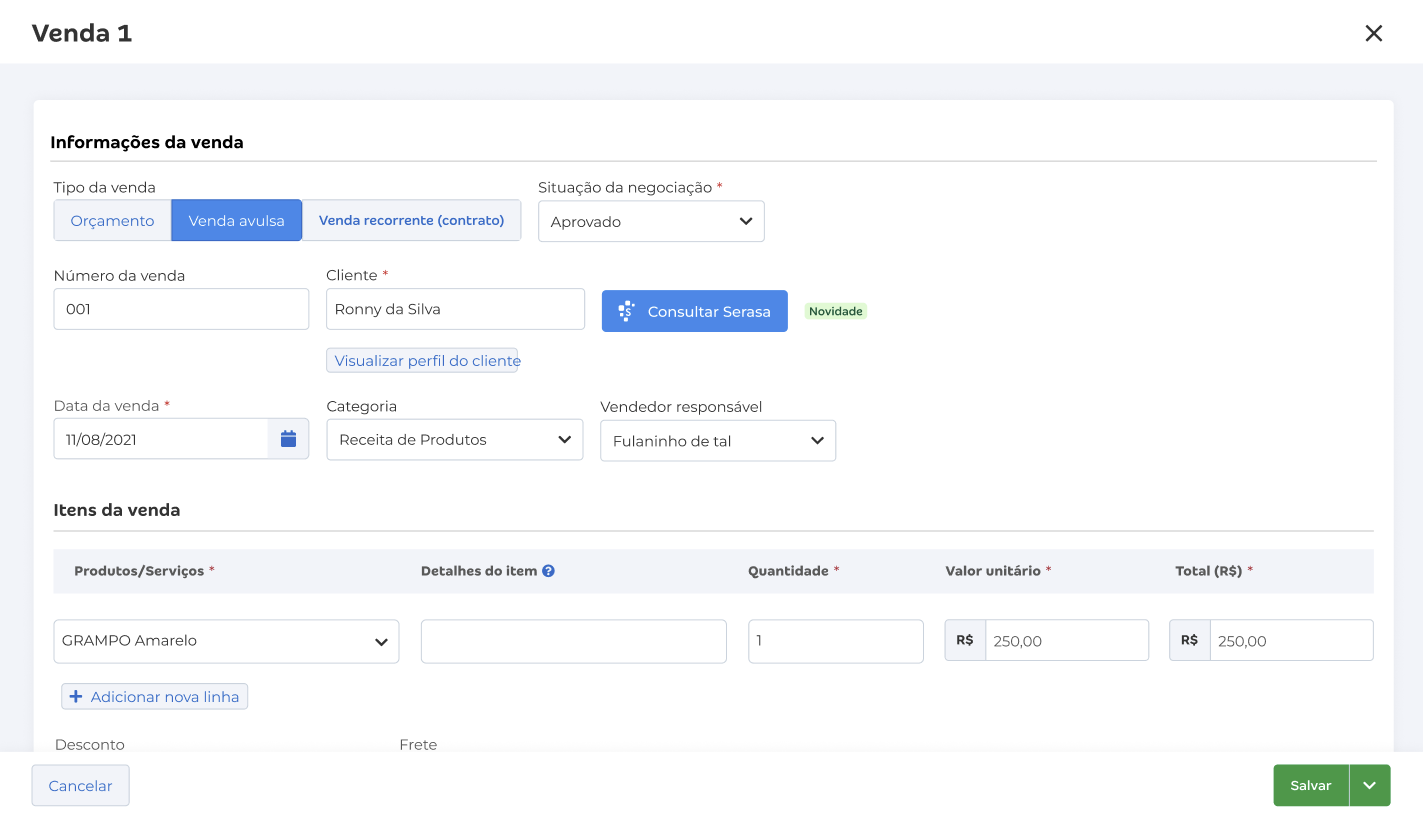
Design decision: I placed the check at the moment of highest intent: one-off sale creation. A single entry point, a minimal flow, focused on validating whether the user would pay before investing in multiple channels.
Check entry point inside the one-off sale creation flow
Result: 16% conversion and R$8,889 in projected revenue, signal enough to move forward to research and V2.
Problem: Research’s most important insight: the user wants to assess risk before formalizing the sale. The MVP only covered the moment after the decision.
Design decision: Direct check as a new main entry point, with no sale required beforehand. More entry points in customer registration and in the customer summary, to cover every moment where credit risk matters in the actual workflow.
Multiple entry points in V2: direct check, customer registration, customer summary, and one-off sale
Result: +677% volume. The direct check led every channel and confirmed the research insight.
638Direct check
172Customer registration
161Customer summary
99One-off sale
54Quote
+677%Volume increase
Breakdown by entry point (V2)
Impact
Validated add-on model
This initiative proved that you can launch a paid, direct-purchase service inside a subscription ERP, with a trust experience good enough to generate consistent revenue. The original OKR was R$268k; the R$213,464 accumulated in the first six months after V2 is a solid proof of concept for the model, even though the potential estimated in prioritization hadn’t yet been reached within the measured window.
Discoverability as a proven growth constraint
The difference between the MVP and V2 wasn’t price, data quality, or trust: it was access architecture. Making the feature discoverable at the right moment multiplied volume by 7.7×. The entry-point breakdown shows the direct check, which didn’t even exist in the MVP, leading every other channel combined in V2. Research predicted exactly this outcome, and V2 confirmed it.
Reusable pattern for paid flows
I designed the interaction model (context → verification → confirmation) with reuse in mind from the start. Any future partner integration involving sensitive data plus pay-per-use inside Conta Azul can inherit this structure without rebuilding the trust logic from scratch.
Honest scope: what was left out
The roadmap called for a V3 of improvements (more complete data such as equity capital and ownership structure, and an evolution of the billing model to reduce post-paid default risk) that hadn’t started within this case’s timeframe. The offer findings documented in research exist as a validated backlog, not as delivery.
Reflection
What this project actually was
A Growth bet with a clear revenue thesis (R$268k OKR, R$16.90 per check), run with a research discipline few Growth teams apply. Integrating credit data into an ERP has existed abroad for years; what changed the game was stopping before V2 to go talk specifically to those who weren’t using it. The product thesis turned into behavioral evidence, and that evidence designed the final architecture.
What remained afterward
Two concrete legacies. First: the context → verification → confirmation interaction pattern as a reusable model for any paid add-on inside the product. Second: practical proof that, for low-adoption features, researching people who don’t use the product yields more learning than researching people who already do. That second point changed how the team came to frame adoption problems from then on.
What I’d do differently
I’d treat post-paid billing risk as a design problem from the MVP itself, not as an operational risk to solve later. Monthly invoice billing with a 30-check cap was designed as a temporary solution, but it went into production with no concrete roadmap for when and how it would evolve. Looking back, potential default was a trust friction just as significant as any interface element, and it deserved the same design attention we gave discoverability. If I did it again, I’d put the billing states (overdue invoice, blocked check, reactivation) in the main flow from V1, not in the V3 backlog.
Protected case
This case is password-protected. Enter the password to access the full process — or get in touch to request access.
Let's work together?
Available for full-time · remote · freelance
Open to new projects, opportunities and conversations.