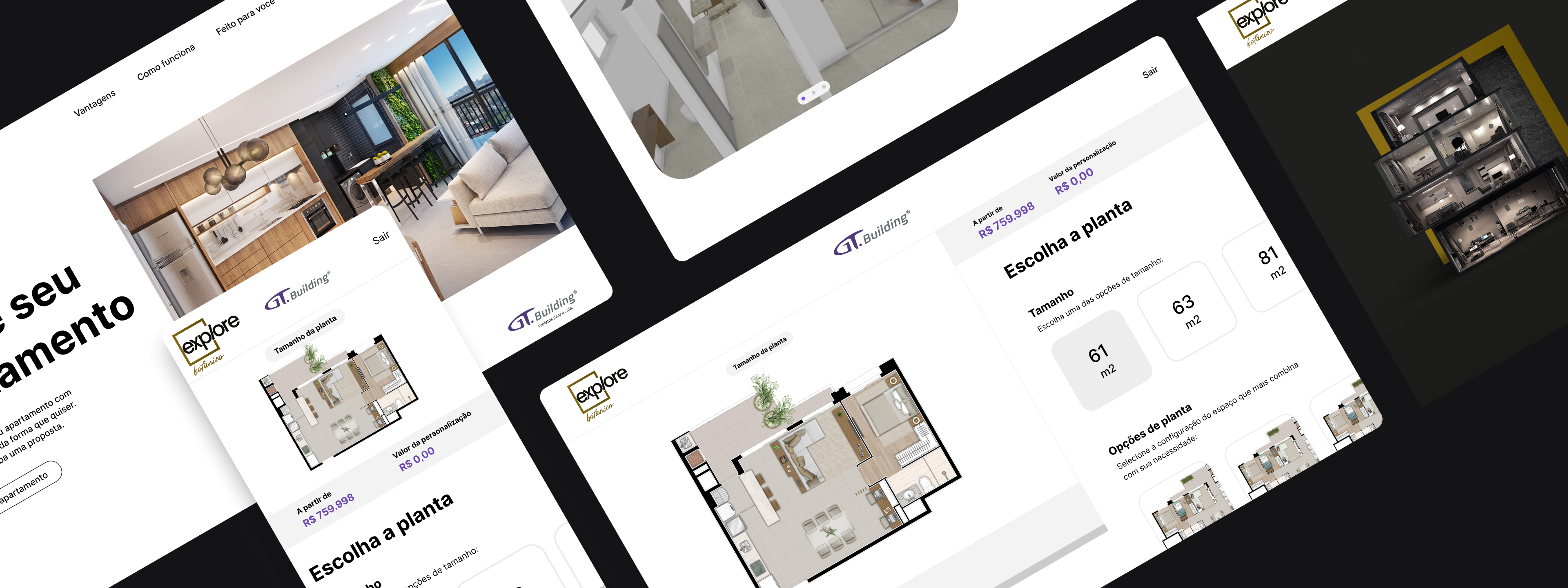
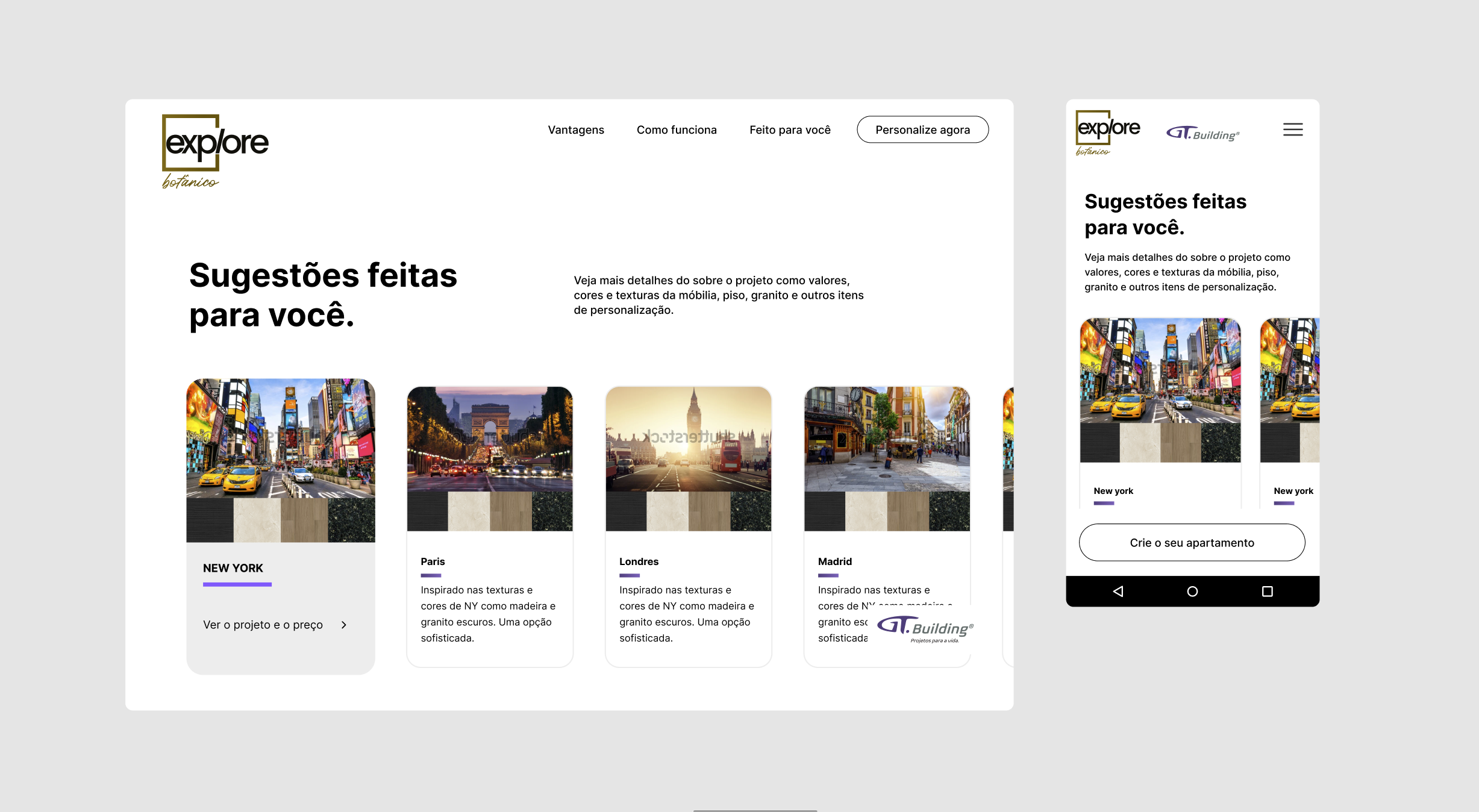
Interactive property configurator that turns the abstraction of buying off-plan into a premium personalization experience
Cross-Platform
Research
Mobile
Real Estate
Lead Gen
Context
GT Building needed a digital tool for the Explore Botânico development that would let buyers visualize and personalize their apartments before closing the deal, reducing the abstraction inherent to buying off-plan.
Problem
Every question about finishes depended on a broker stepping in, creating friction that delayed the purchase decision. There was no way for the customer to reach the negotiation with choices already made.
Approach
Interactive configurator built on cross-industry benchmarking (Porsche, Renault, Youse, Apple), product decisions grounded in research with 159 respondents, and three distinct flows for different user profiles.
Result
+40% lead quality, 100% automation in lead capture and handoff to the broker, and three complete flows delivered on October 25, 2021.
Results
+40%Lead qualityChoices already made
3×Flows deliveredB2C · B2B · converted
100%Capture automationVia CRM and WhatsApp
25Documented meetingsJun–Oct 2021
82%Receptive to 3DValidated keeping 3D
11%Want full personalizationValidated curated combos
Role
I worked as Product Designer, responsible for user research, flow definition and information architecture, wireframes, UI and a navigable prototype in Figma, product decisions alongside the client, experience benchmarking, handoff, development follow-up, and pre-launch visual QA. The project involved 25 documented meetings between June and October 2021, delivered on 10/25/2021.
Strategy
The problem sat at the intersection of a complex decision and the lack of a tool to support it. Any question about finishes, room layout or materials could only be answered with a broker nearby. That stretched out the negotiation cycle, made every lead more expensive, and left closing in the hands of several contact points that could have been anticipated.
Digitizing the process that already existed would solve little. The real gain was in getting the buyer to reach the broker with choices already made. With that, the sales visit stops being the time to answer questions and becomes the time to confirm them.
Process
The project was split into 5 phases across 25 meetings: Discovery (parallel kick-offs with UX, 3D and development teams, audience and scope mapping), Flow Definition (end-to-end journey validated), Prototype Iterations (critical architecture decisions), Refinement (added scope and additional use cases), and Pre-Launch (bugs, copy and final QA).
Every product decision came from research, not guesswork. I kept the 3D component even though it was expensive to implement, because 82% of users were receptive and 81% tolerated the load time. And I adopted the pre-defined combo strategy because only 11% of respondents wanted to personalize everything.
Research-Driven
Cross-Industry Benchmark
Multi-Profile Flows
Handoff & QA
Diagnosis
Question: What do high-end buyers need in order to make the personalization decision with confidence?
What was done: Quantitative research with 159 respondents mapping decision behaviors, receptiveness to specific UI components (3D, interactive configurators), and personalization preferences.
Key finding:44% research extensively before deciding, which justified keeping the 4 concept screens before the configurator. 82% receptive to 3D and 81% tolerant of load time supported keeping the component despite the technical cost. And only 11% want full personalization, which validated the bet on curated combos.
Artifact: Data that grounded the critical product decisions: inclusion of 3D, curation vs. total freedom strategy, structure of the pre-configurator flow.
Question: What is the best available configuration and product-presentation experience standard, regardless of industry?
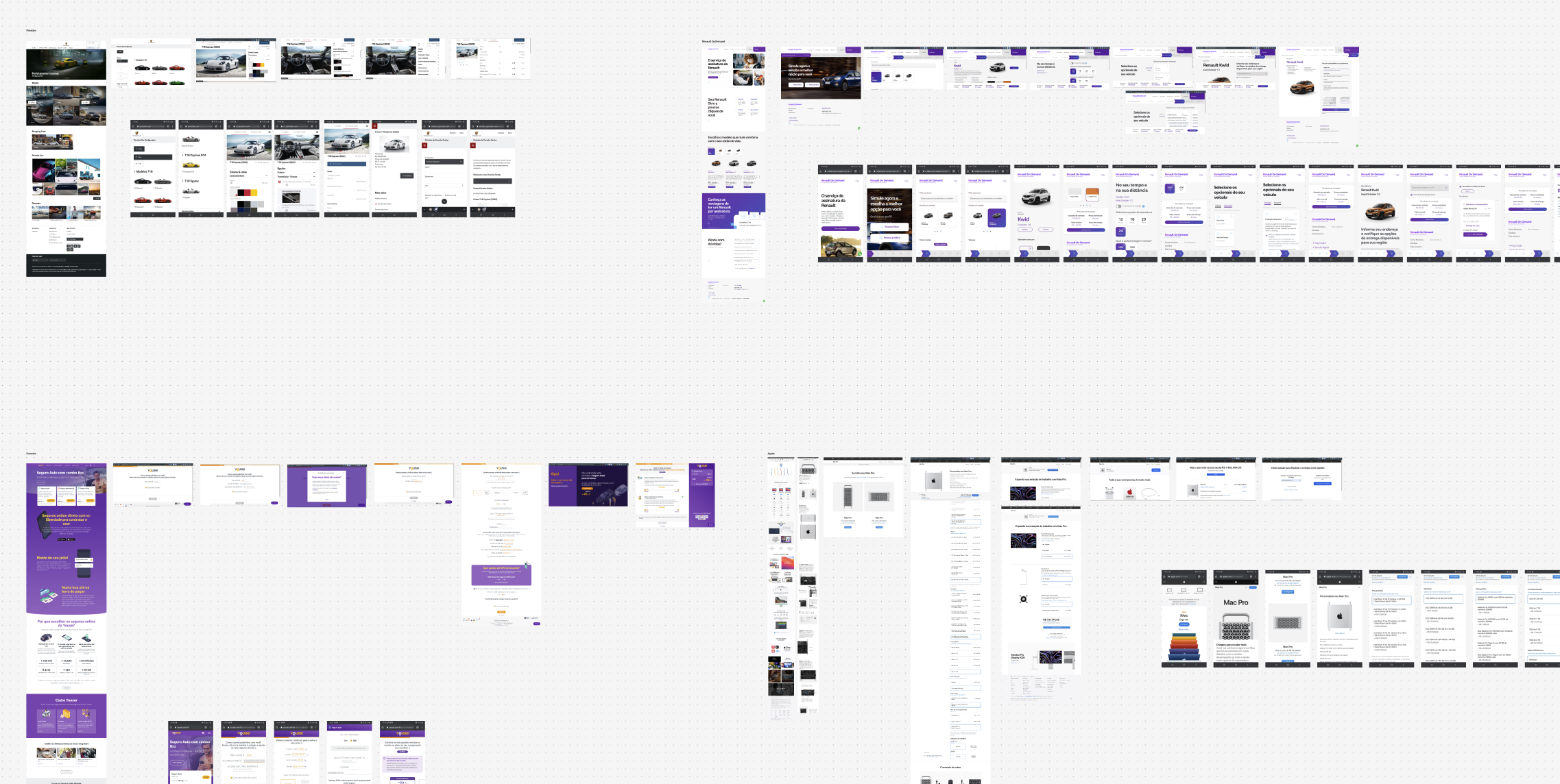
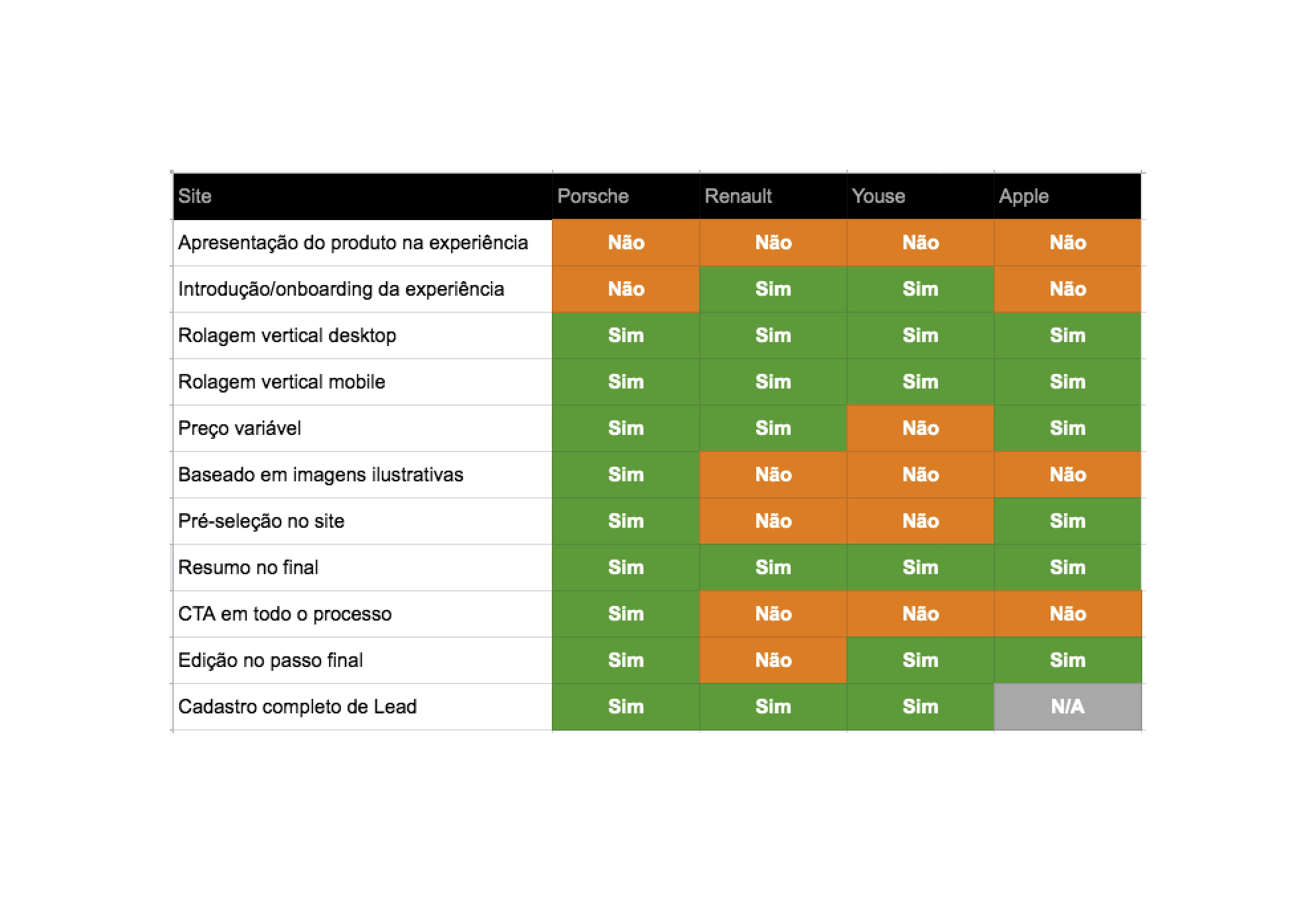
What was done: Comparative analysis of four references outside the real estate market (Porsche, Renault, Youse and Apple) across eleven criteria: product presentation, onboarding, desktop and mobile scrolling, variable pricing, use of illustrative images, pre-selection, final summary, continuous CTA, editing at the final step, and lead capture.
Key finding: Porsche led on most configuration criteria (variable pricing, pre-selection, summary, continuous CTA, final editing and lead capture), but fell short exactly on product presentation and onboarding, the same two points where Renault, Youse and Apple also stumble. No reference solves presentation well before personalization, which reinforced keeping the 4 concept screens before the configurator on Explore Botânico. Well-curated, well-presented combos build more confidence in the decision than total freedom, the standard Porsche set and that I followed.
Artifact: Comparative matrix that raised the expected quality bar for the product and grounded keeping the concept screens.
Comparative matrix of criteria evaluated across Porsche, Renault, Youse and Apple
Question: How does the current sales process work, and where does the configurator fit in?
What was done: Mapping of the sales flow with GT Building stakeholders, from initial lead contact through closing. Identification of friction points that depended on broker intervention.
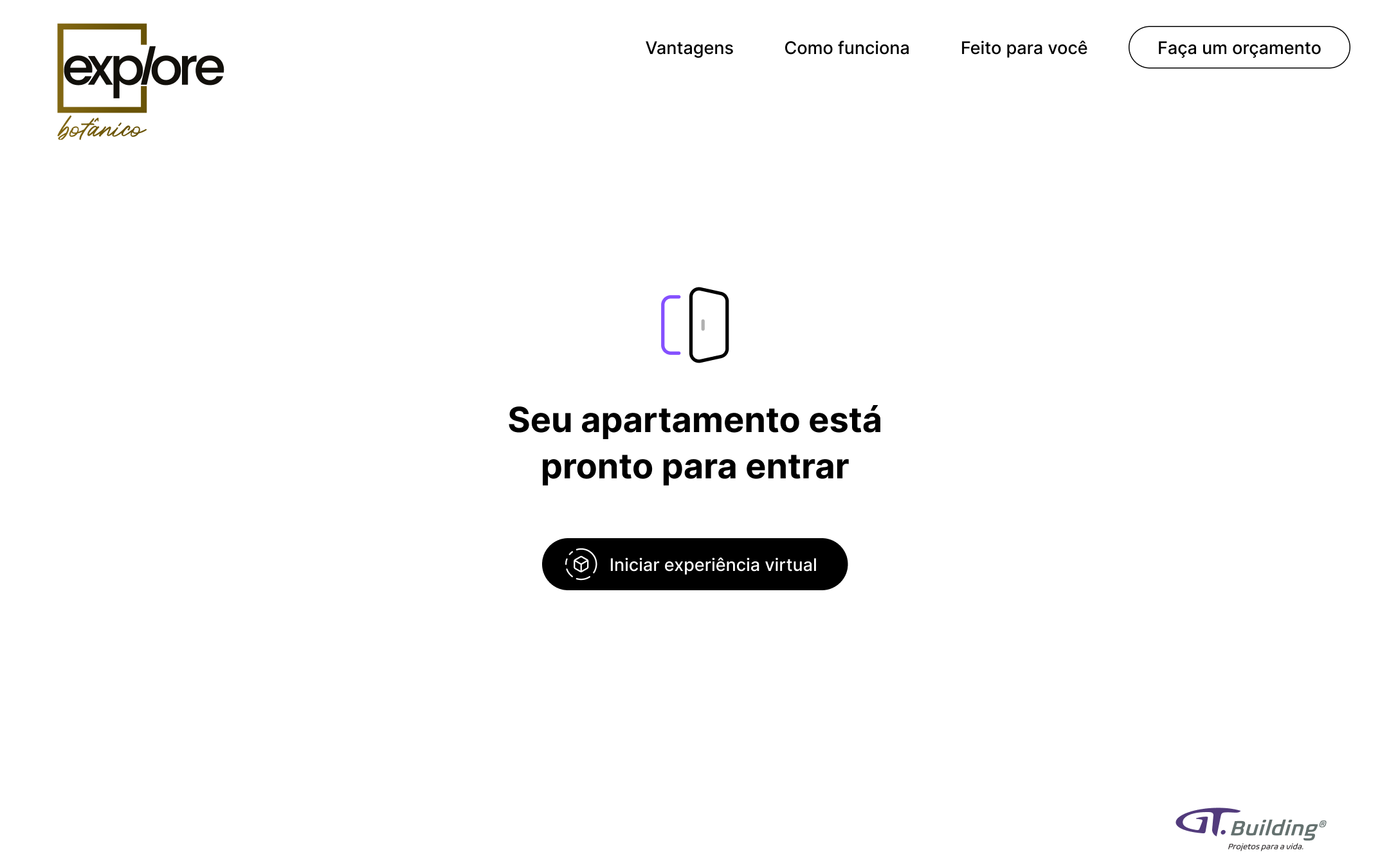
Key finding: Validated journey: Landing Page → Concept (4 screens) → Configurator → Form → Broker notification via WhatsApp. The configurator doesn’t take the broker out of the picture; it prepares the lead for the conversation.
Artifact: Journey flow validated with the sales and technology teams.
Solution
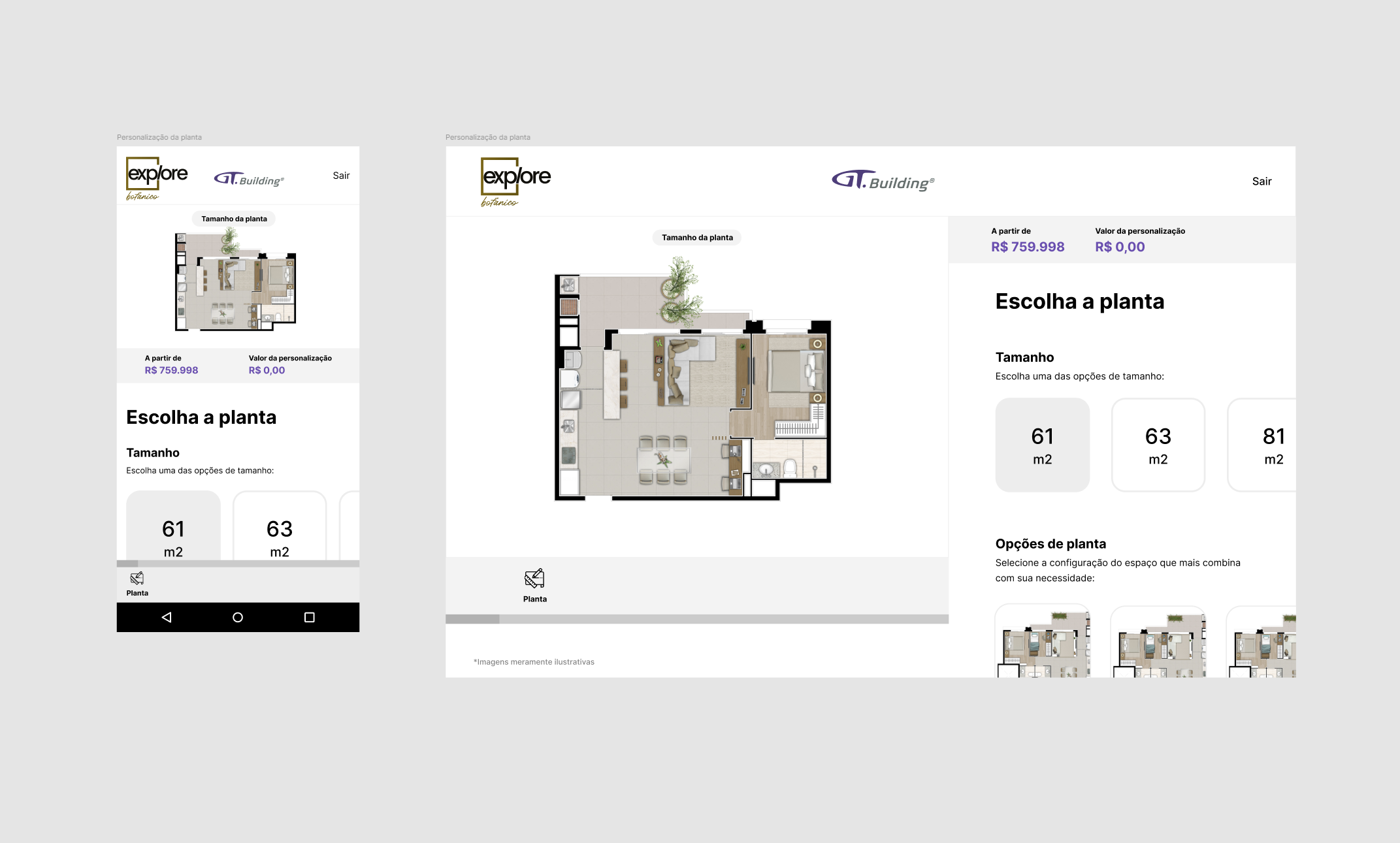
Problem: Personalizing an off-plan property involves layered decisions: size, floor plan, furniture and finishes. The buyer needed to navigate them without getting lost or losing sight of the impact of each choice.
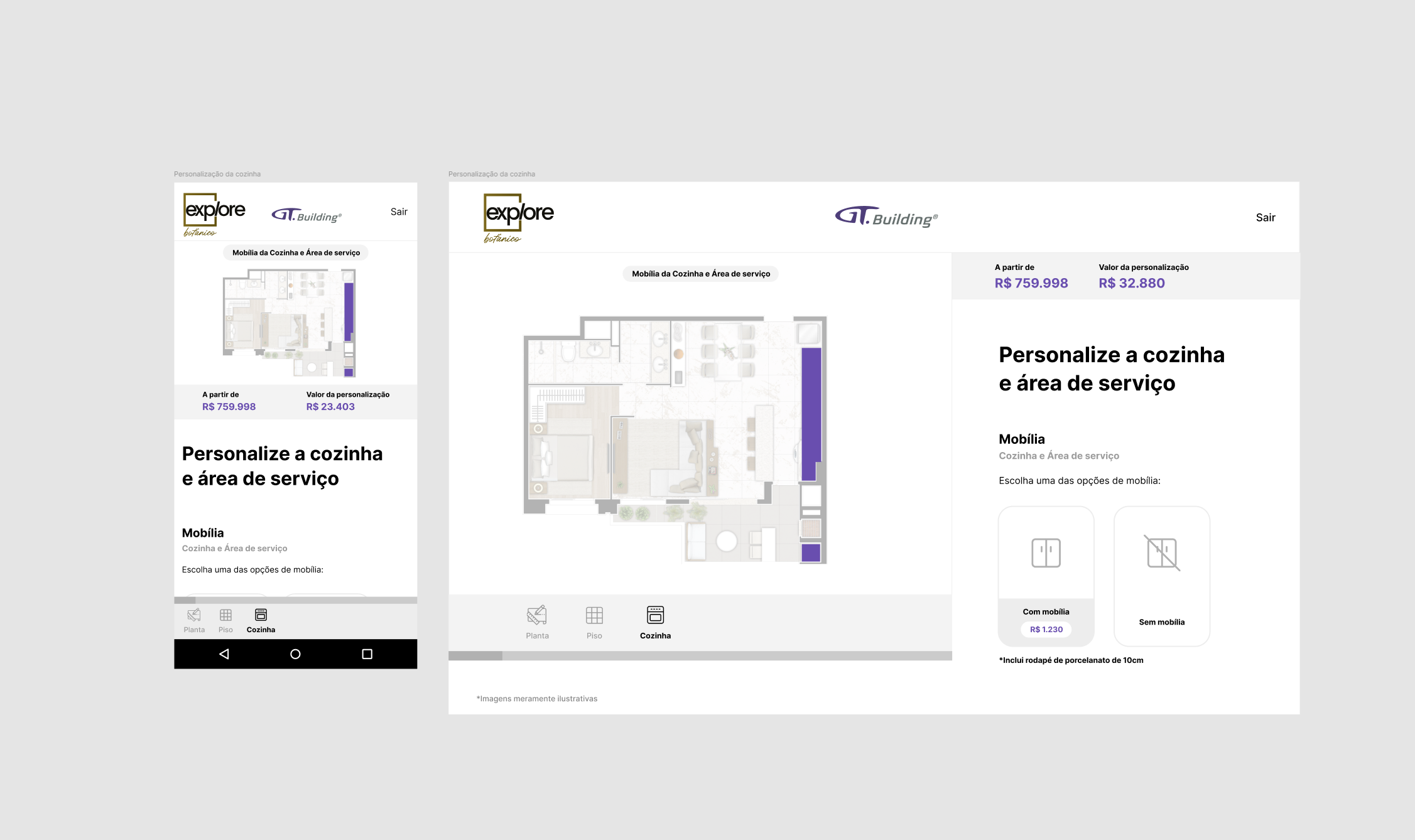
Design decision: I structured personalization into sequential steps: first the apartment size, then the floor plan options compatible with that size, and finally furniture and finishes per room. Each choice updates the 3D view and a fixed header showing “Starting from” and “Personalization value” in real time, so the financial impact tracks the decision without interrupting the flow.
Personalization step: choosing the apartment size and floor plan
Problem: GT Building operated with two sales channels: GT Exclusiva (its own channel) and partner real estate agencies. Each channel had different data-capture needs and distinct permissions.
Design decision: Two independent carts: one to generate leads for GT Exclusiva (with full data collection) and another for partner agencies (no data collection, just the configuration ID). I separated them on purpose, because a system serving B2C and B2B at the same time needs clearly distinct flows.
Problem: Personalizing a property is a decision buyers tend to revisit at different times. If they had to start from scratch every time, that would create friction and loss of intent.
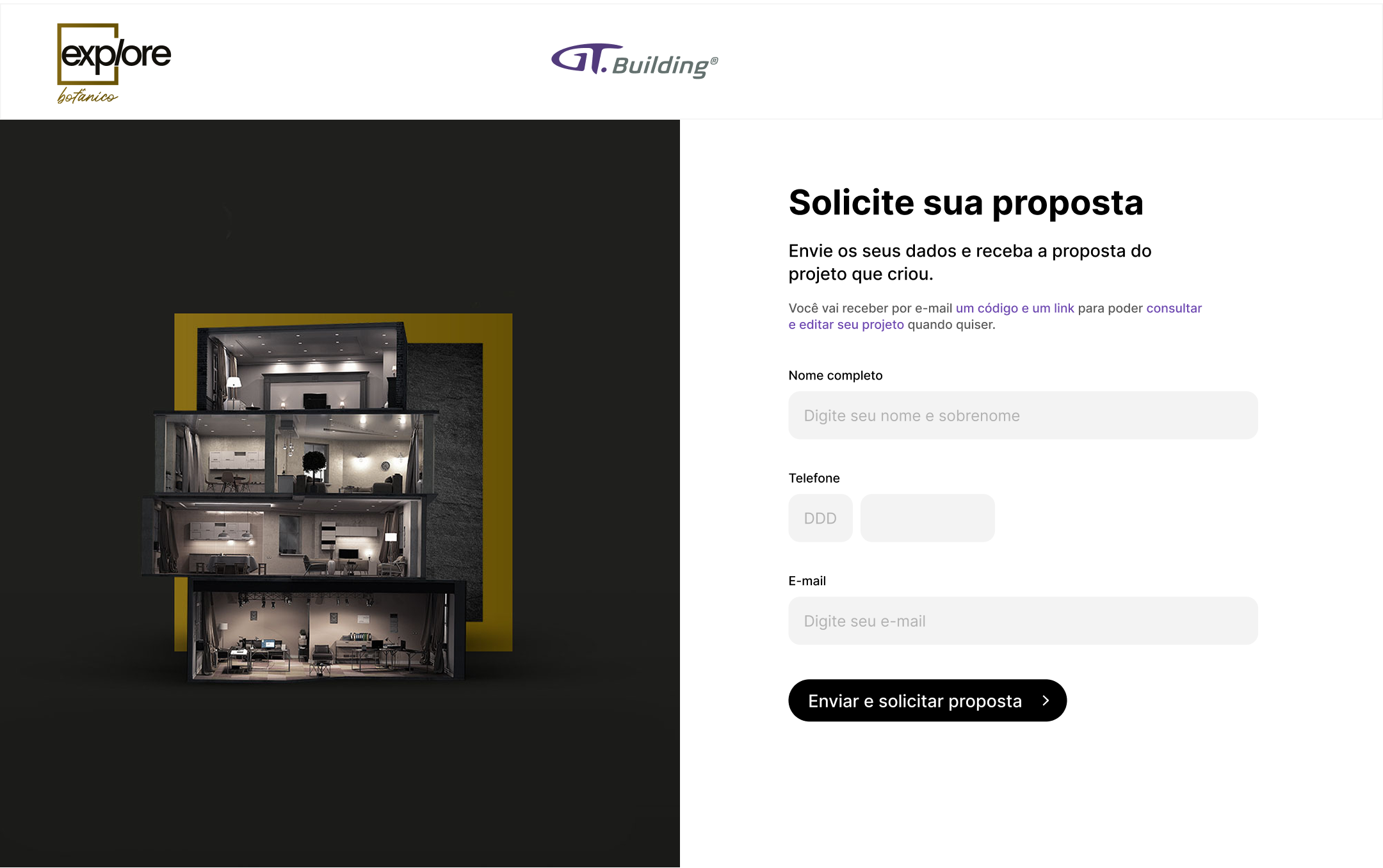
Design decision: A unique ID per configuration, saved to the buyer’s email and automatically transmitted to the broker via CRM. The customer resumes the configuration without starting over; the broker receives the ID with all choices already made.
Final form with code generation and email link to resume the configuration
Problem: The 3D component weighed on technical cost and load time. Whether to keep it had to be a grounded decision, not an aesthetic choice.
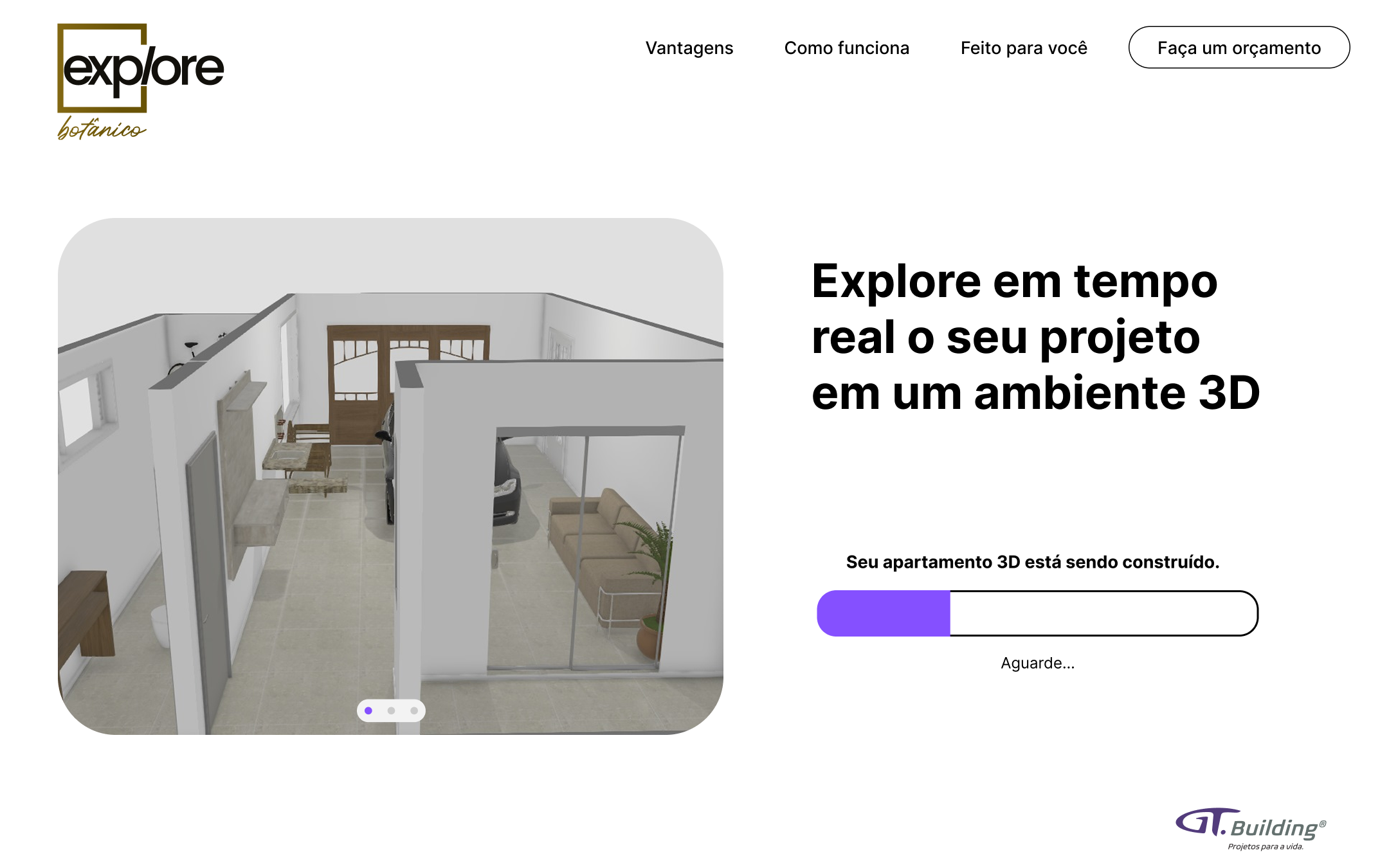
Design decision: I kept the 3D because research backed it up: 82% of respondents were receptive and 81% tolerated the load time if the functionality was worth it. And it was: visualizing finishes before buying an off-plan property is exactly the kind of feature that justifies the cost.
Loading state of the 3D component during apartment construction
Problem: Only 11% of buyers want to choose everything. For everyone else, too many options create decision paralysis.
Design decision: Pre-defined personalization combos (floor plan, flooring, cabinetry, heating) instead of total personalization. I presented curation as a premium selection, not a limitation. Fewer options, well presented, build more confidence at decision time.
Curated combos of finishes presented as themed suggestions
Problem: Managers and coordinators needed to access carts by ID to track and retrieve configurations, but each profile needed different permissions.
Design decision: Backoffice with two profiles: GT Exclusiva Manager and Real Estate Agency Coordinator. Each profile accesses only the carts relevant to its channel, with distinct viewing and retrieval permissions.
Impact
Capture automation
Lead, ID and cart reach the broker via CRM and WhatsApp, with no manual handling. The sales team receives a complete package, not just a contact.
Post-conversion flow
During refinement, scope grew to include a specific flow for those who had already closed the deal, allowing them to revisit and confirm their personalization choices after conversion. This extension emerged during the design process; it wasn’t in the original scope.
Collaborative process
25 documented meetings over 5 months, with the client, the 3D team and development. That volume of alignment gives a sense of what it took to integrate UX, 3D visualization, CRM and automation into a single product, on a fixed deadline.
Reflection
What this project actually was
The deliverable was a sales tool, but the work was product work. A pretty interface wasn’t enough: I needed to understand the sales funnel, the needs of the B2C and B2B channels, the technical limits of 3D, and the CRM automation logic. The decision that mattered most was aiming outside the real estate industry (Porsche, Renault, Youse, Apple) instead of copying competitors in the segment. Calibrating the bar against the best in class, rather than the sector average, changed the product that came out.
What remained afterward
I left this project with three lessons I’ve used ever since: benchmarking outside the segment raises the standard; research unlocks hard decisions; and, when the user’s choice is complex, well-executed curation helps more than total freedom. A product that serves B2C and B2B at the same time also demands architecture designed with separate flows as a design decision, not a technical limitation.
What I’d do differently
I’d define the backoffice scope earlier, still during diagnosis. The different permissions between Manager and Coordinator only surfaced midway through the project; if they’d been mapped during Discovery, they would have avoided a round of architecture rework. B2B complexity always shows up later than it should.
Let's work together?
Available for full-time · remote · freelance
Open to new projects, opportunities and conversations.