Removing the ERP's main activation barrier with AI-assisted data import
AI-Augmented
Onboarding
Activation
Revenue
Conversational UI
Context
The most consistent finding from the activation journey: before creating the first sale, the user needed customers already registered; before issuing an invoice, services already registered. Manual data entry was the wall between account creation and product value.
Problem
Manual entry of setup data consumed 30–45 minutes of every new onboarding session, all spent before any value-creating action. For most users, that friction was enough to cause abandonment before activation.
Approach
AI-assisted conversational import flow: the user uploads a spreadsheet, the AI extracts and maps the fields automatically, the user reviews and confirms. Setup in minutes, not hours.
Result
+44% feature interest · 22% active engagement · 16% flow completion. Early-stage validation signals, not full rollout.
Results
+44%Feature interestDeclared interest
22%Active engagementStarted the flow
16%Flow completionCompleted the import
Role
I was the Product Designer responsible for this initiative, from initial alignment through the MVP Alpha prototype. The scope included leading the CSD with two product PMs, exploring three UI alternatives, and developing the prototype in direct partnership with the Design Manager.
The exploration of alternatives went through engineering, directors, GPMs and PMs before closing. There was one criterion: the path had to converge with the business’s long-term vision, and it did. AI-assisted onboarding became Conta Azul’s first step in delivering customer value with AI inside the product.
The decision to go with the Chat format (instead of a Wizard or integration with Captura AI) went beyond an interaction decision. It meant handing the scope to the Conta AI team, with support from the Growth team. I navigated institutional uncertainty about how AI would be used in the product: the project documentation noted that this flow could see unplanned changes as Conta Azul Pro’s AI vision evolved. Moving forward with MVP Alpha, instead of waiting for a complete definition, was a calculated risk decision.
Strategy
The OKR was direct: raise 30-day activation for subscribers without assisted onboarding from 27% to 40% (excluding the bulk channel). The core metric was Time to Value, the time until the user recorded their first sales data. Manual registration entry was the biggest blocker on that path.
In ERPs, the standard approach to this problem is CS-guided onboarding: a human walks the user through manual data entry. It scales poorly, because CS cost grows with the user base, and that was exactly what we wanted to replace in the segment without assisted onboarding.
The AI performed one specific mechanical task: mapping the fields in the user’s spreadsheet to the product’s fields. Pattern recognition, not judgment, and the AI solves it in seconds. Separating roles was the most important design decision: the AI handles the technical mapping, the user validates the business data. That resolves trust (the user controls what enters the system) and friction (the user doesn’t do the mechanical work) at the same time.
The real tension was timing: AI integration into Conta Azul Pro was still being defined while we were designing. Choosing Chat anticipated the Conta AI vision, but depended on a product decision still open. I designed MVP Alpha to generate signal before that decision became a blocker.
Process
The sequence was defined before any wireframe: align on uncertainties, research existing solutions, explore models, decide with explicit criteria.
CSD with the product team: a structured survey of Certainties, Assumptions and Doubts with the two PMs. Result: a list of hypotheses about desire, usability and perceived value that shaped the MVP’s learning expectations.
Internal desk research: mapping of previous initiatives in the Inbox and Conta AI developments documented by other designers. This avoided rework and connected the initiative to the long-term vision already present in the product.
AI in SaaS benchmark: a study focused on how interfaces solve AI integration for file import in B2B products. It identified that file import as a core feature was the standard for delivering perceived value quickly.
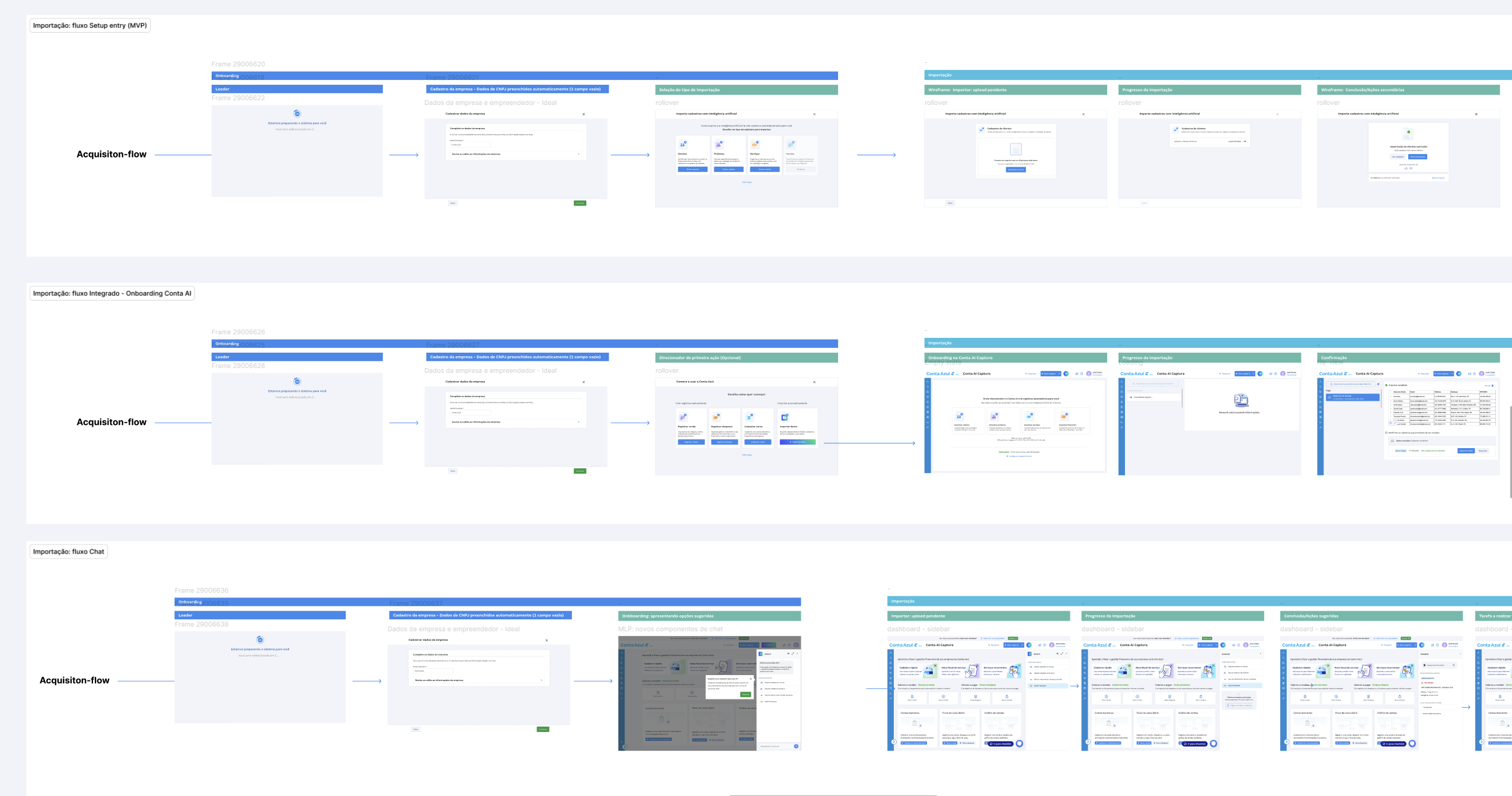
Exploration of 3 UI models: prototyping and comparing: (1) an Import Wizard (an experience separate from Conta AI); (2) Integrated into Captura AI (within the existing visual experience); (3) AI Chat (a static chat experience, no text input, clicks only).
MVP Alpha with a restricted audience: launched to new users across roughly 10% of the eligible base, covering registration of Customers, Products/Services and Expenses. Learning expectations were defined before launch: Desire (% adoption, main point of abandonment), Usability (understanding of the flow, clarity of the value proposition, ease of review) and Perceived Value (qualitative feedback on the AI experience).
Diagnosis
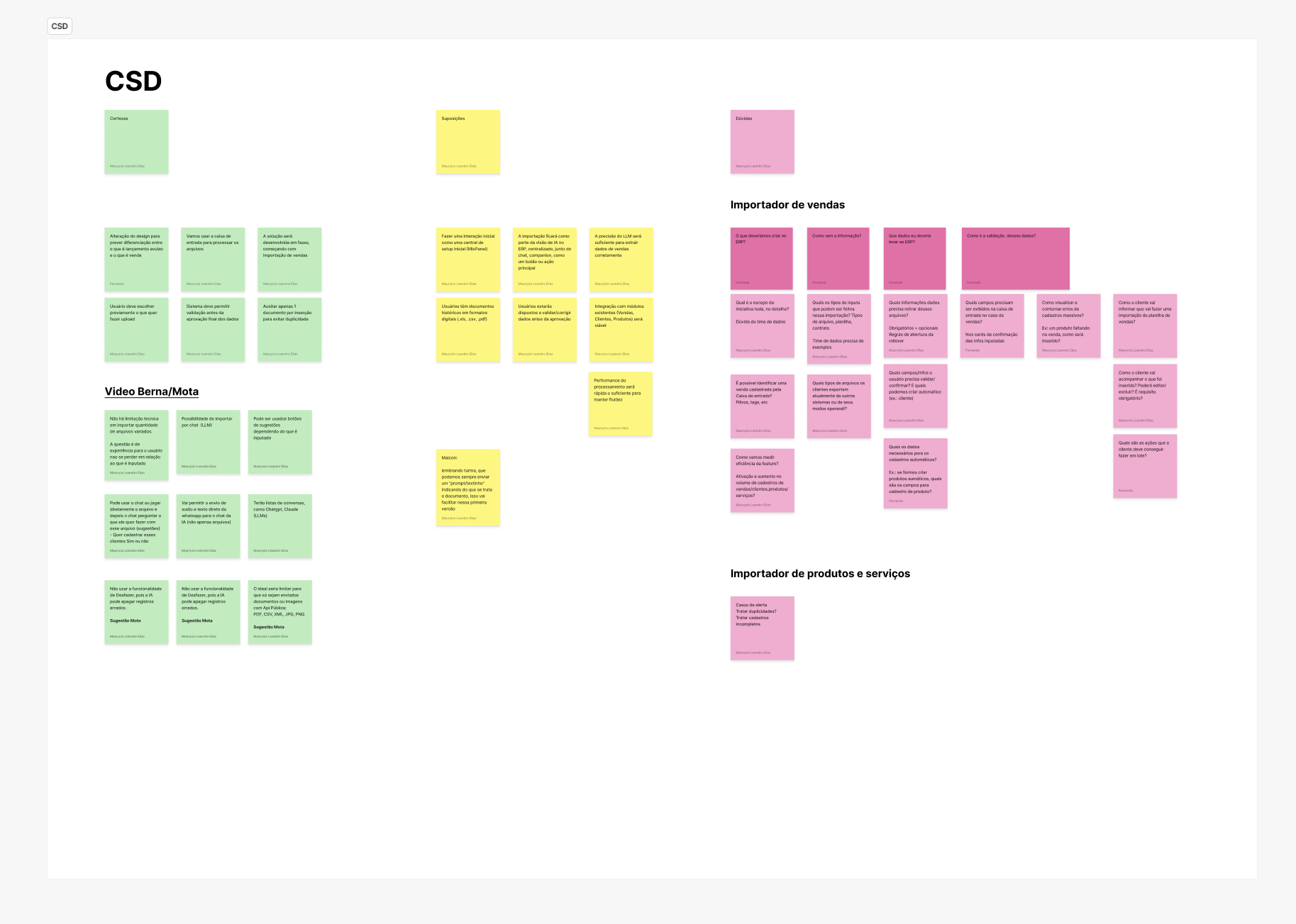
Question: What are our certainties, assumptions and doubts about wanting, using and trusting AI-assisted import?
What was done: A CSD workshop run with the two product PMs as an initial alignment tool before any solution exploration.
Key finding: The team’s biggest doubt wasn’t about desire (there was clear signal that users wanted out of manual entry). It was about trust: does the user trust that the AI mapped the data correctly without checking field by field?
Artifact: CSD map with prioritized hypotheses; fed directly into MVP Alpha’s learning expectations.
CSD map with the product team: certainties, assumptions and doubts about AI-assisted import
Question: What had already been tried or documented internally about data import and Conta AI’s evolution?
What was done: Research into previous initiatives in the Inbox and a review of other designers’ documentation on Conta AI’s evolution.
Key finding: The existing import function was outdated and didn’t work for customers’ real needs. CS reported recurring difficulties with registrations. A future vision for Conta AI was documented, but without concrete implementation yet.
Artifact: Synthesis of previous initiatives; gap map between what existed and what the user needed.
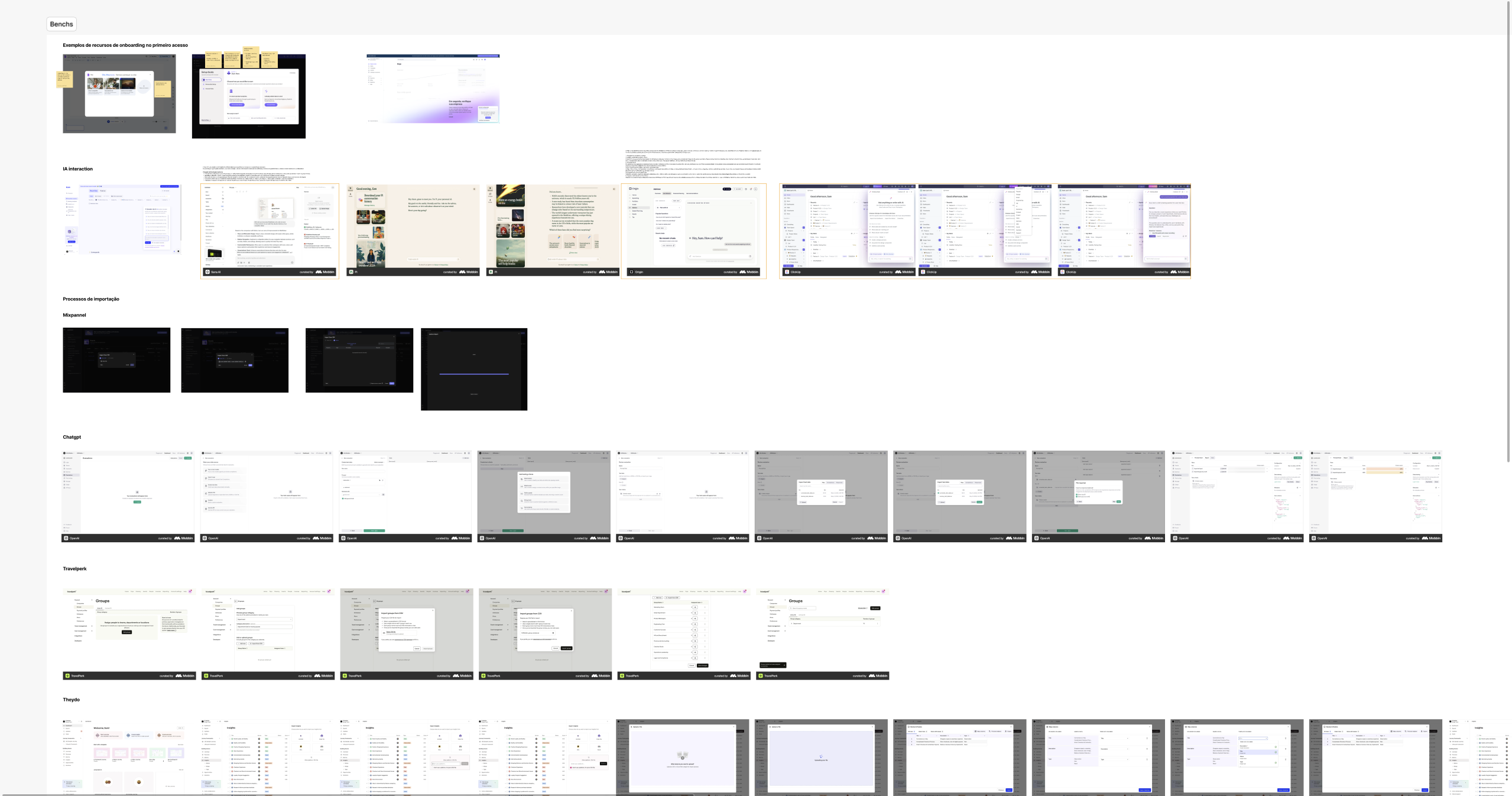
Question: How do B2B SaaS products solve AI integration in file import flows for onboarding?
What was done: A comparative study focused on file import as the core value-delivery feature in AI-assisted onboarding.
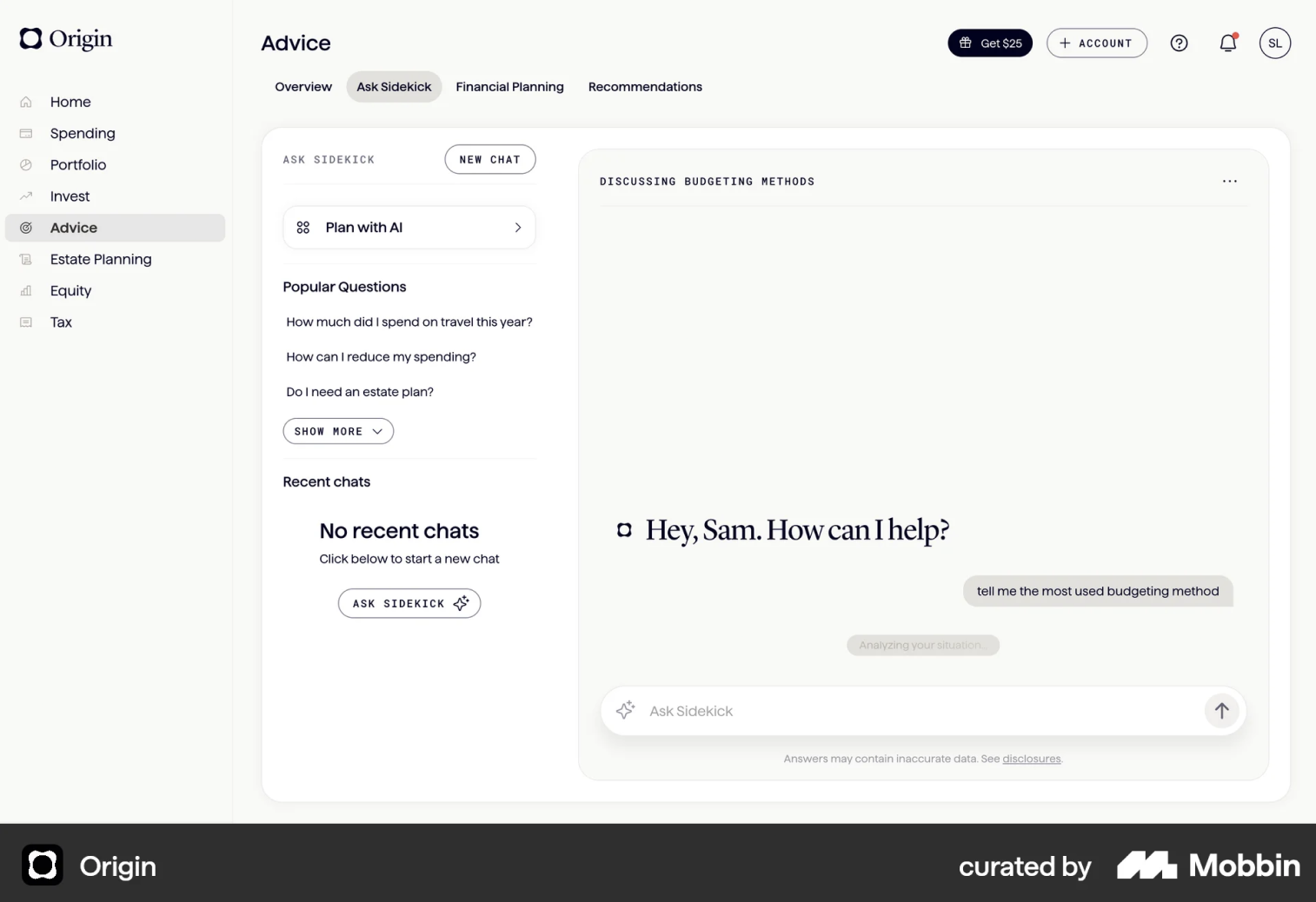
Key finding: The market pattern converges on: upload → automatic processing → user review → confirmation. Products that skip the review step register higher rates of perceived error and post-import abandonment. The review step isn’t optional: it’s what makes the AI trustworthy.
Artifact: Benchmarking panel with UI pattern analysis; reference for interface decisions on the review screen.
Benchmark panel: AI import flows in B2B SaaS
Question: Which UI model best distributes cognitive load between AI and user, given the context of critical business data?
What was done: Prototyping and structured comparison of three models: an Import Wizard (an experience separate from Conta AI), Integrated into Captura AI (within the existing visual experience) and AI Chat (static chat, no text input, clicks only).
Key finding: The Wizard and the Captura AI integration shifted mapping complexity to the user in different ways: the user still had to make configuration decisions. Chat hid that complexity: the AI maps, the user just reviews and clicks. For the target user profile (new users unfamiliar with the product), reducing decisions mattered more than configuration flexibility.
Artifact: Comparative wireframes of the three models; decision matrix with criteria for cognitive load, alignment with product vision, and development feasibility.
Wireframes of the three models side by side: Wizard, Captura AI integration and Chat
Solution
Problem: How do you reduce the friction of manual setup without shifting the mechanical work onto the user in a different form?
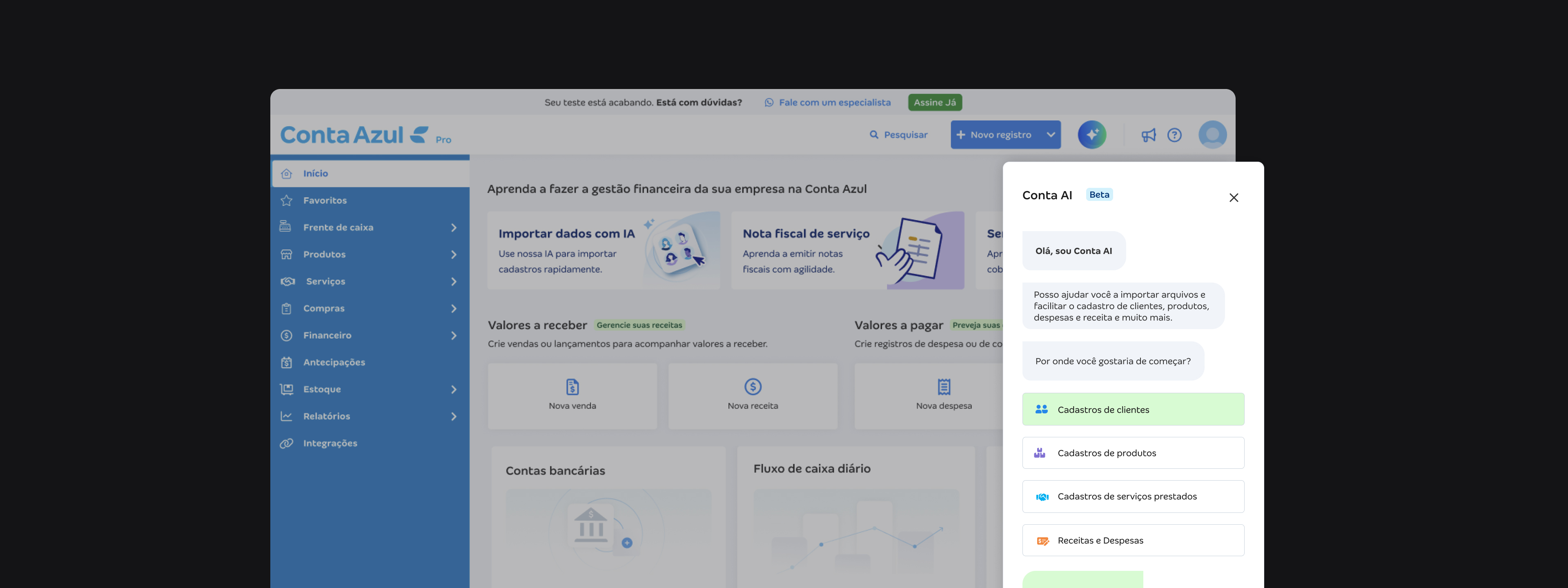
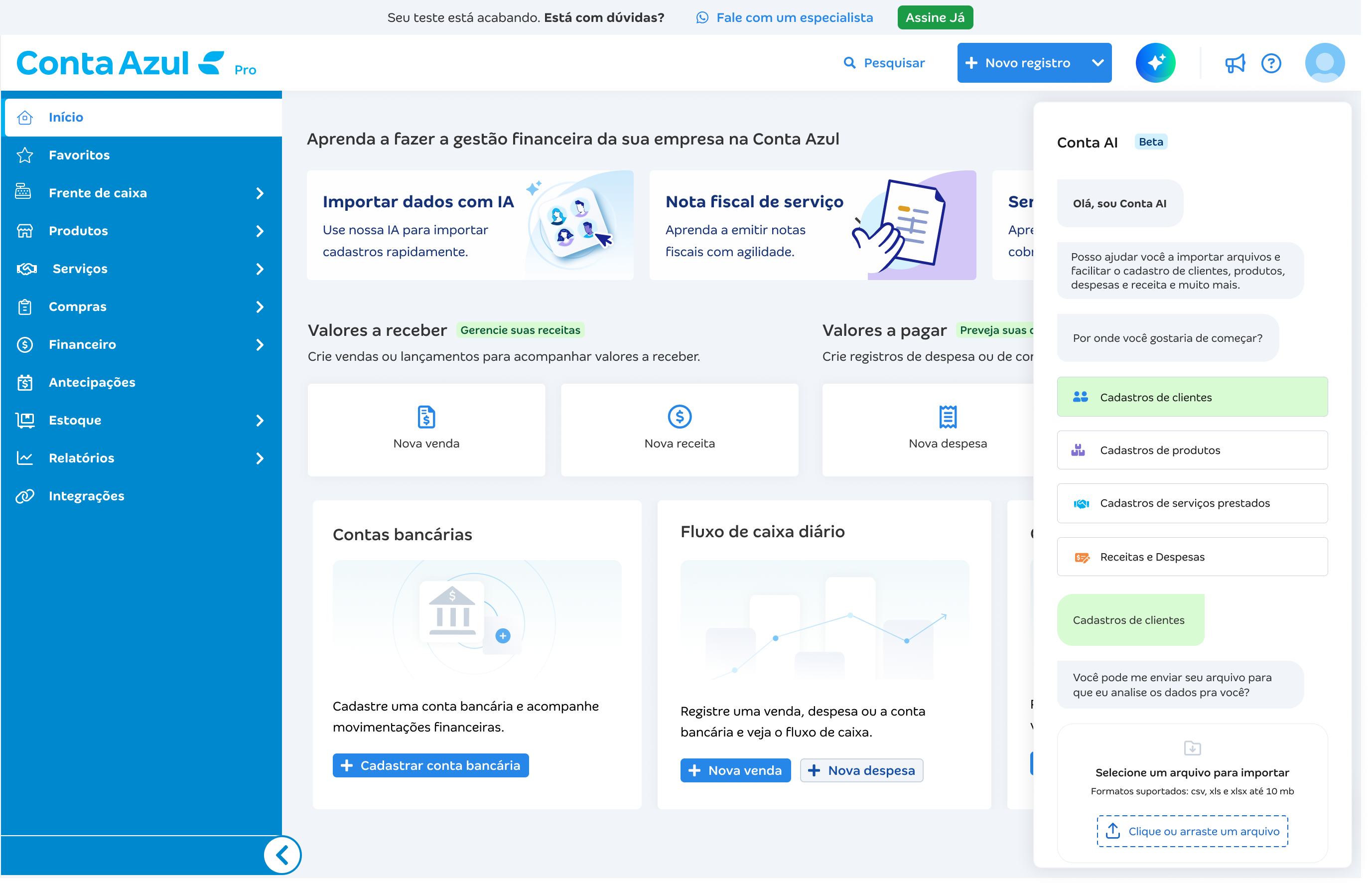
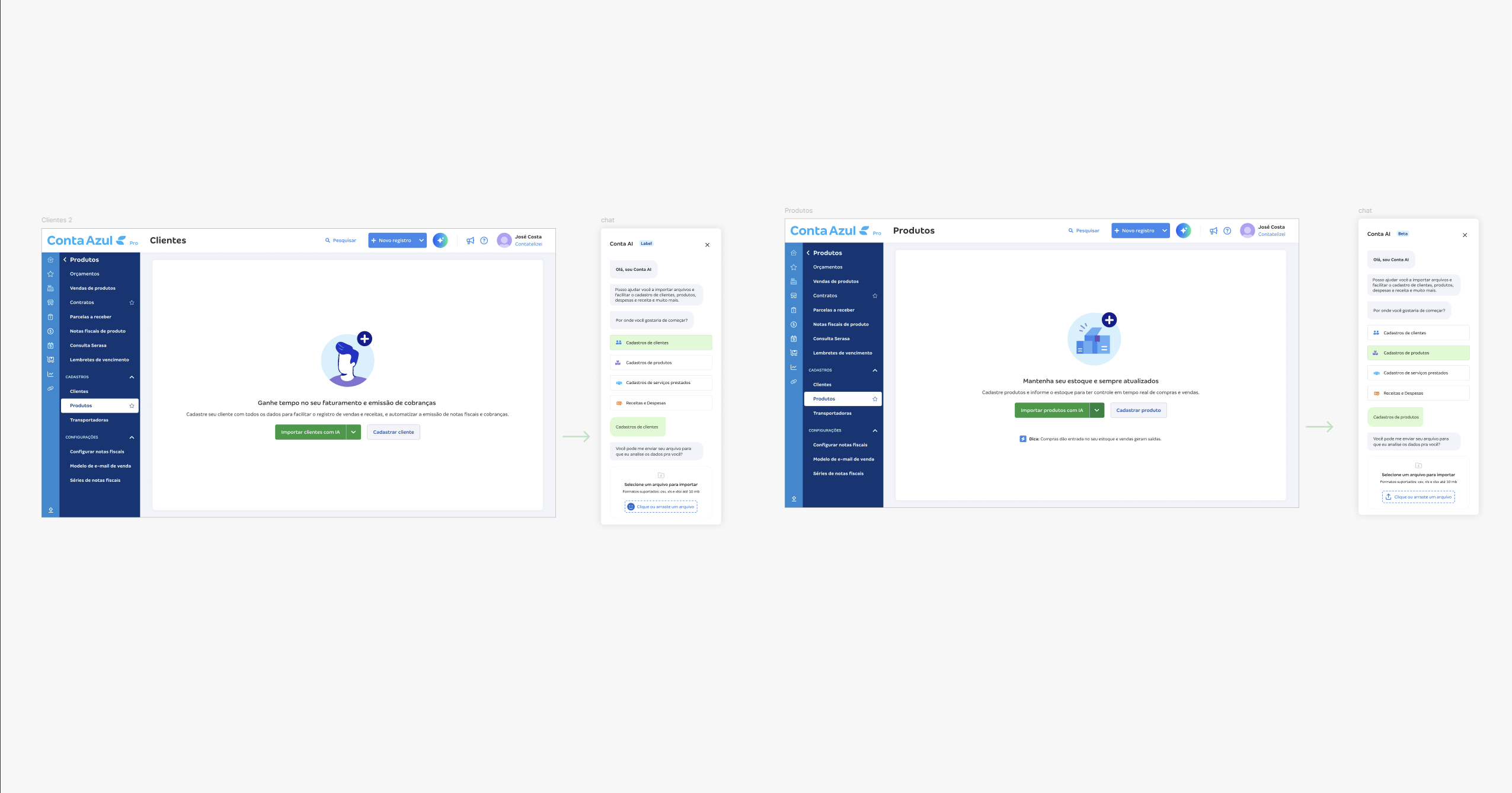
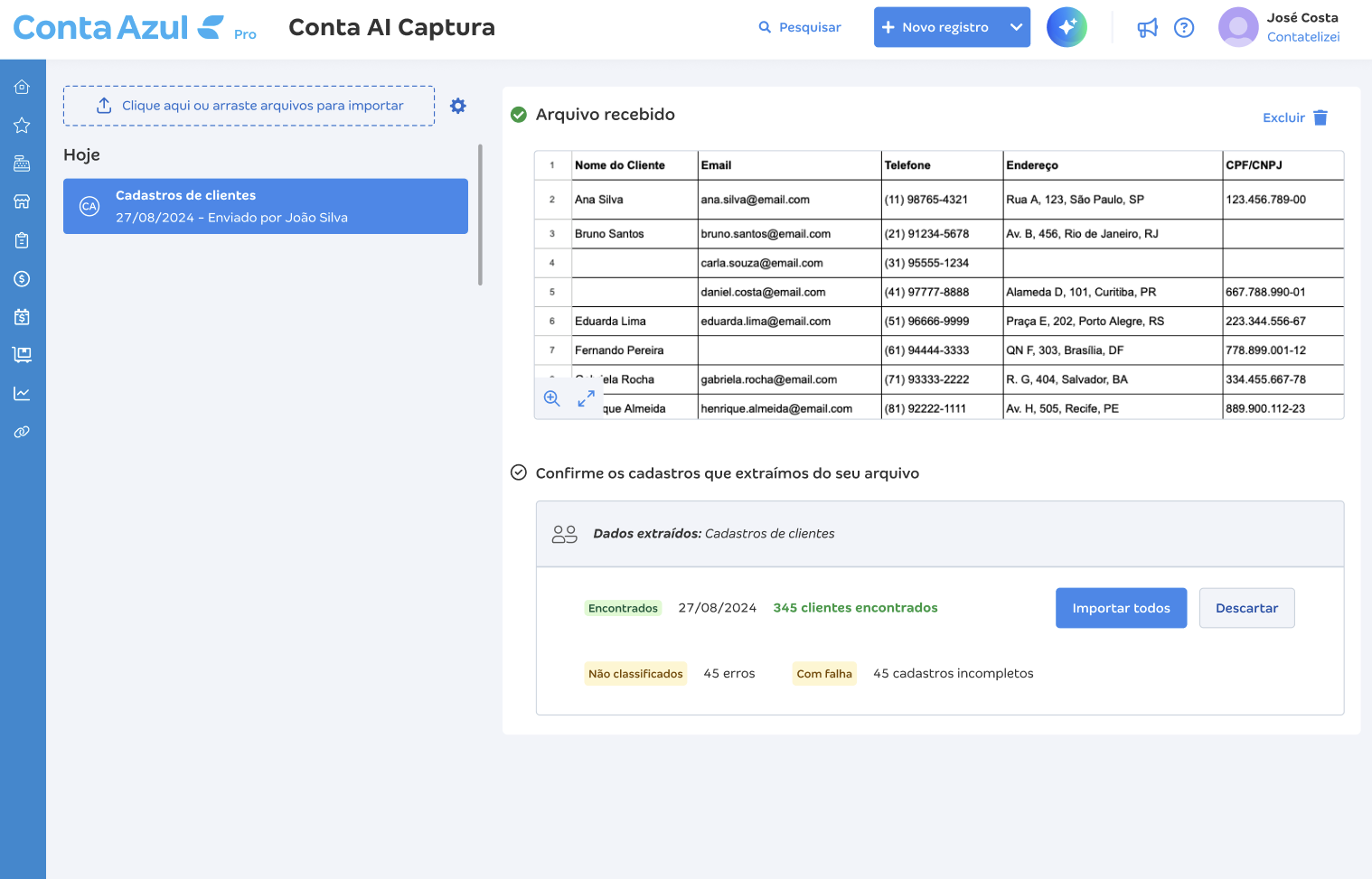
Design decision: A chat-based interface: the user uploads the spreadsheet, the AI drives the process. The interaction is review and confirmation, not configuration. The user doesn’t choose mappings; they validate what the AI suggests. MVP Alpha covered the three registration types with the highest impact on Time to Value: Customers, Products/Services and Expenses. The chat was implemented as static (no free text input, only clicks on predefined options) to reduce variability and make it easier to validate the AI’s behavior at this stage.
Flow entry point: AI import card on the home screen
Problem: Users need to trust that the AI mapped the data correctly before confirming an import that could overwrite existing data.
Design decision: A review screen with a clear view of the mapping (original field → product field) with inline editing for individual corrections. Explicit confirmation before any change hits the database. The user keeps full control; the AI reduces effort, not judgment.
Review screen: data extracted from the spreadsheet with confirmation before import
Problem: Three different UI models reached the table before the final decision, each with distinct trade-offs in cognitive load and alignment with the product vision.
Design decision: Exploring wireframes for the three models revealed that the Wizard and the Captura AI integration shifted mapping complexity to the user in different ways. The conversational UI hid that complexity entirely: the AI maps, the user reviews. That analysis was the direct input for the decision to adopt Chat and hand the scope to the Conta AI team.
Wireframes of the three models side by side: Wizard, Captura AI integration and Chat
Reflection
What this project actually was
A bet on timing: designing trust for AI in a context of critical data before the product’s AI vision was fully defined. The technical design work (splitting AI/user roles, the review screen, the static chat) was a consequence of an earlier strategic decision: generate a validation signal before institutional uncertainty about AI in the product became a blocker.
Going from 27% to 40% activation in 30 days wasn’t going to come from UX fine-tuning. The jump required changing the structure of the problem: removing manual data entry from the path between account creation and product value.
What it meant for the product
This project was Conta Azul Pro’s first AI case delivering direct customer value in production. The MVP Alpha result became a reference for leadership deciding Conta AI’s next steps: which interaction format to scale, where to invest engineering, how to measure adoption in flows that touch critical business data. The role separation tested here, the AI maps and the user validates, went on to guide other squads assessing where to apply AI in the product.
What stayed afterward
The trust architecture developed here (upload → automatic mapping → user review → explicit confirmation) is reusable for any AI flow operating on critical business data. The split between what the AI decides (technical mapping) and what the user decides (business validation) is a design principle, not a one-off solution. The future vision documented in the project (MLP with connection to sales history, active contracts and centralized integration with the chat system) was recorded and can feed subsequent iterations as the product’s AI vision matures.
What I’d do differently
I’d set quantitative success criteria before launch with more rigor: specifically, what would count as sufficient signal to scale vs. pivot. The qualitative criteria (Desire, Usability, Perceived Value) were clear; the numeric thresholds for the continuation decision were implicit. Given the risk of a shift in the product’s AI vision (a documented, real risk, not a hypothetical one), that upfront clarity would have protected the team from ambiguous interpretations of the Alpha results.
On the 16% completion rate: market benchmarks show that import flows in B2B SaaS typically register between 10–25% session completion. The 16% figure sits within that range. I’d make that context explicit from the start, as part of the evaluation framework agreed with stakeholders before launch, not as a defense after the fact.
Protected case
This case is password-protected. Enter the password to access the full process — or get in touch to request access.
Let's work together?
Available for full-time · remote · freelance
Open to new projects, opportunities and conversations.